
Recent crime data reveals a massive shift in India’s counterfeit money routes, placing Chhattisgarh just behind Karnataka and Assam in total seizures.
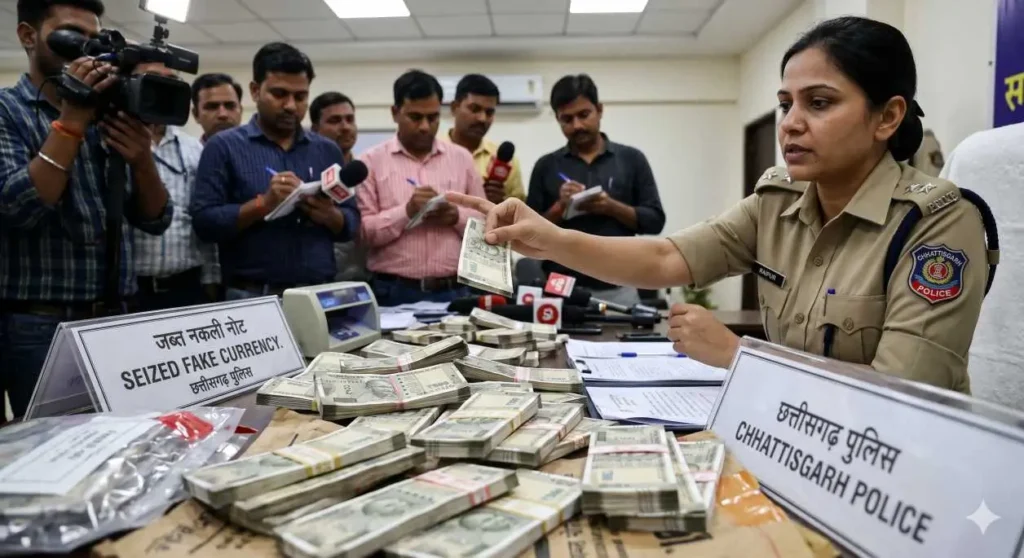
RAIPUR, 10 May 2026 — Fake currency rings have turned Chhattisgarh into a premier transit hub, and they’ve pushed the state to the third highest position in national counterfeit seizures. Police and federal agencies pulled ₹3.8 crore in fake Indian notes from the state’s economy over the last recorded year. Karnataka topped the list with a staggering ₹32 crore, while Assam followed at ₹4.9 crore.
The National Crime Records Bureau dropped these figures this week, shattering the long-held assumption that international border states exclusively control the fake cash trade. West Bengal, historically the epicenter of counterfeit infiltration from Bangladesh, didn’t even break the top three, recording just ₹1.5 crore in seizures.
And that massive geographic shift isn’t accidental. Syndicate bosses exploit precise logistical vulnerabilities. Chhattisgarh shares porous borders with seven different states, making it a smuggler’s paradise. Couriers use the dense, heavily forested routes coming in from Odisha and Jharkhand to move high-quality fake ₹500 notes into the financial arteries of central India.
They aren’t printing this money in local basements. Intelligence reports consistently point to sophisticated overseas printing presses. The notes cross the eastern border, but instead of lingering in Bengal where the Directorate of Revenue Intelligence watches every shadow, the cash moves fast. It heads straight for the heartland.
“We aren’t dealing with crude colour photocopies anymore,” an anti-terror squad investigator confirmed during a recent security briefing in Raipur. “They’ve mastered the security threads. They’ve replicated the watermarks. They match the exact colour gradient of the current ₹500 denomination.”
But why is so much of this dirty money landing in Chhattisgarh? It isn’t a coincidence.
The state’s massive industrial corridors and cash-heavy agricultural markets provide the perfect cover for washing bad money. Couriers mix counterfeit bundles with legitimate cash during the intense paddy procurement seasons. They filter it through the unorganised sector, paying daily wage labourers in construction and mining. If you want to disappear a few lakh in fake notes, a bustling rural mandi in Bastar or a wholesale market in Bilaspur is exactly where it’s done.
The state’s geography presents another unique nightmare for law enforcement, as vast tracts of southern Chhattisgarh remain highly militarised due to the ongoing Maoist insurgency. While there’s no direct public evidence linking insurgents to the latest spike in high-grade fake currency, the sheer volume of unpoliced territory provides the ultimate blind spot for smugglers. Cash couriers bypass main highways entirely, using rural roads that police rarely patrol after dark without heavily armed convoys.
This blind spot explains why Karnataka’s numbers sit so high. Karnataka’s ₹32 crore seizure largely represents end-point busts—they’re catching syndicates trying to dump massive volumes of cash in a booming tech and real estate hub. Chhattisgarh’s ₹3.8 crore, however, represents transit busts. It’s the money caught in the pipeline before it reaches the final buyer. The fact that police are pulling crores out of transit vehicles here indicates the true scale of the operation is terrifying.
Local police forces face a severe resource gap when tracking these sophisticated networks. Beat cops can’t spot a high-grade fake note by eye, and rural precinct stations don’t possess advanced ultraviolet scanning equipment. Law enforcement relies almost entirely on human intelligence and informant tip-offs. When the intelligence fails, the cash enters the local bloodstream.
The damage hits the lowest economic rungs the hardest. A vegetable vendor in Durg who unknowingly accepts a fake ₹500 note loses a day’s profit. When they try to use it later, the note gets confiscated, and they absorb the entire loss. The syndicates operating out of the shadows shift the financial ruin onto the citizens who don’t have a safety net.
Other states show wildly different figures in the NCRB report. Telangana seized ₹1.57 crore, and they’ve slotted into the fifth position nationally. Andhra Pradesh and Maharashtra numbers fluctuate wildly year on year, but they pale in comparison to the steady volume currently sitting in Chhattisgarh’s evidence lockers.
The Reserve Bank of India routinely maintains that overall counterfeiting remains manageable. Bank statistics show they detect roughly two fake notes for every million notes in circulation. The central bank views this as a negligible threat to the macroeconomic system. Bank teller data, however, doesn’t capture the street-level reality, because banks only catch what criminals are foolish enough to deposit.
Most of this fake cash won’t ever see the inside of a bank vault.
It circulates entirely within the informal economy. It pays for illicit country liquor, funds local narcotics networks, and greases the wheels of illegal sand mining operations. The Enforcement Directorate’s ongoing investigations into the massive ₹2,883 crore Chhattisgarh liquor scam show exactly how much unmonitored cash moves through the state’s shadow economy. While the ED probe focuses on political kickbacks and systemic extortion, the hawala infrastructure used to move that cash is exactly what counterfeiters exploit. Smugglers don’t care if they’re moving dirty political money or freshly printed fakes; the delivery networks are identical.
So the ₹3.8 crore seized by police likely represents a fraction of what’s actually out there. Security analysts and criminologists generally work on a ten percent rule—for every bundle law enforcement seizes, nine don’t get caught. That places the potential volume of fake currency circulating in Chhattisgarh near a staggering ₹38 crore.
The ₹500 note remains the undisputed favourite. Ever since the government withdrew the ₹2,000 note from circulation, counterfeiters shifted their entire production capacity to the lower denomination. It’s high enough to turn a massive profit for the syndicates, but low enough to avoid the intense, immediate scrutiny a larger bill attracts at a cash register.
State law enforcement has begun tightening the net around key transport hubs. Highway patrols now routinely check inter-state transport trucks. However, smugglers have already adapted to these static checkpoints, and they don’t use large commercial trucks anymore. They use the vast railway network, private hired cars, and even domestic couriers who have no idea what’s hidden inside the parcels they carry.
The latest NCRB report serves as a harsh indictment of current internal security protocols. State lines mean nothing to criminal syndicates, yet police forces remain siloed in their respective jurisdictions. They don’t share intelligence fast enough. They fail to track the couriers across borders.
Until authorities treat counterfeit currency as a coordinated attack on the nation’s financial integrity rather than a series of isolated local crimes, the syndicates won’t stop printing. They’ll just find a new route.




Leave a Reply