
India’s currency hit a lifetime low of 96 against the dollar as the ongoing Iran conflict chokes off critical LPG and crude imports.
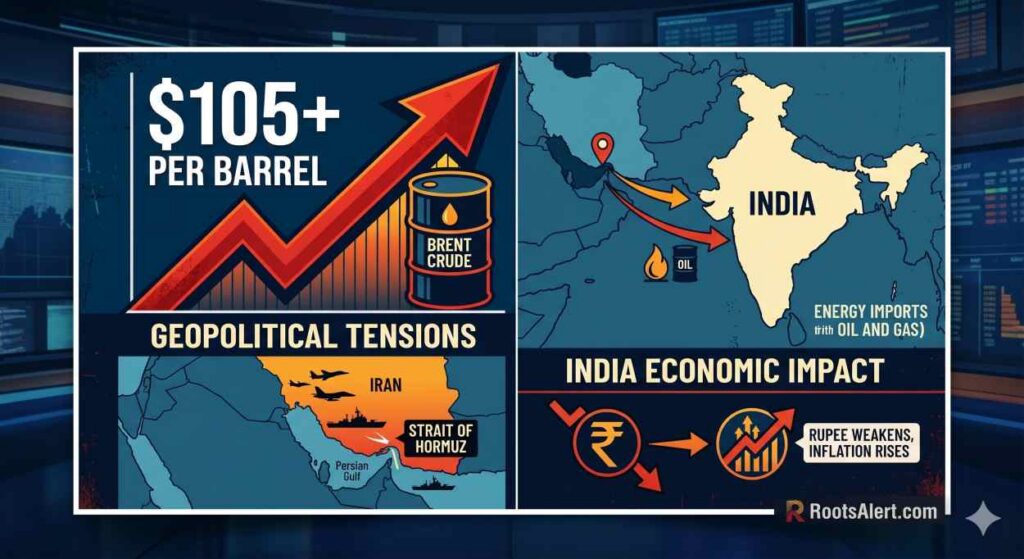
NEW DELHI, May 16 — India’s rupee plummeted to a lifetime low of 96.14 against the US dollar on Friday as the ongoing blockade of the Strait of Hormuz chokes the nation’s energy supply. The currency collapse mirrors the relentless climb of Brent crude, which has now settled above $105 per barrel. It hasn’t dropped below the $100 threshold in weeks. The blockade, enforced by Iran for 75 days following a coalition air war, has effectively paralysed the world’s most critical maritime chokepoint.
And the fallout on the ground in India isn’t just theoretical; it’s immediate and brutal.
India relies on the Strait of Hormuz for 50 percent of its crude oil, 85 percent of its liquefied petroleum gas, and 55 percent of its liquefied natural gas. With traffic through the channel reduced to a fraction of pre-war levels, India’s crude stocks have plunged by 15 percent, according to data released this week. Global bonds have sold off sharply as institutional investors price in the likelihood of a prolonged energy shock. Yields are surging as markets bet that central banks won’t be able to cut interest rates while supply-side inflation runs rampant.
The crisis is ripping through the domestic market. In Bengaluru and Chennai, hotel associations warn that thousands of restaurants will face forced closures within 48 to 72 hours due to catastrophic commercial LPG shortages. Households aren’t faring much better. The waiting period for a standard cooking gas cylinder has stretched to 25 days in several states. Oil Marketing Companies are bleeding cash, losing roughly Rs. 12 on every litre of diesel they sell, as per analysis from PL Capital. The structural deficit is compounding daily, forcing smaller distributors to admit they can’t sustain operations entirely.
But how long can the government shield consumers from the true cost of $105 oil when the treasury can’t keep absorbing the losses?
The Reserve Bank of India has actively intervened in the foreign exchange market to stall the rupee’s free fall. Central bank officials initiated heavy dollar sales to manage the widening trade deficit, which ballooned to $28.38 billion in April. Prime Minister Narendra Modi addressed the mounting pressure last week. He urged citizens to curb gold purchases and limit international travel to preserve the country’s dwindling foreign exchange reserves. Policymakers are scrambling to manage an external sector that’s looking increasingly precarious, as foreign institutional investors pull capital out of emerging markets.
This isn’t a temporary market glitch. Global energy analysts at JPMorgan Chase & Co. issued a report on Monday projecting that oil prices will remain in the low $100s for most of the year. The investment bank’s data indicates that even if Iran reopened the Strait of Hormuz tomorrow, the logistical backlog and damaged infrastructure would prevent a quick correction in supply chains. Tanker availability has cratered, and shipping rates have skyrocketed to reflect the massive risk premiums they’ve been forced to adopt.
“The rupee has entered a self-reinforcing cycle,” said Anil Kumar Bhansali, Head of Treasury at Finrex Treasury Advisors. Geopolitical tensions trigger foreign investor outflows, which sink the currency. That depreciation makes India’s massive energy import bill even more expensive, reinforcing the panic. India imports nearly 90 percent of its crude oil. Economists estimate that every one-dollar sustained increase in crude prices drains an additional $2.5 billion from the Indian economy, a figure the country simply can’t afford.
So the financial strain compounding on Dalal Street isn’t the whole story.
The physical risk to Indian assets and citizens in the Persian Gulf remains extraordinarily high. In early March, a projectile struck the oil tanker Skylight north of Oman, killing two Indian crew members and injuring three others. Another drone attack on the MKD VYOM killed an Indian sailor and forced a complete evacuation. The region is a war zone, and marine insurance companies have yanked war-risk coverage entirely for the area, because they won’t underwrite voyages that are financially toxic.
In Parliament, the government faces mounting pressure to secure alternative energy routes. External Affairs Minister S. Jaishankar has repeatedly advocated for diplomacy, though bilateral talks haven’t yielded anything concrete. Opposition leaders are demanding transparency regarding the nation’s strategic petroleum reserves and exactly how long the country can survive a sustained supply cutoff. The political heat is rising alongside the inflation metrics, with state elections looming and voters increasingly angry about the cost of living they’re facing.
US President Donald Trump and Chinese President Xi Jinping met in Beijing this week, but their discussions failed to produce a breakthrough regarding the Iran conflict. China remains Iran’s largest oil buyer, absorbing discounted crude while bypassing the heavily disrupted formal shipping channels. Iran has reportedly reached separate arrangements with Iraq and Pakistan to move its own product overland or through alternative ports, leaving nations like India, which depend on standard international shipping lanes, to bear the brunt of a blockade they didn’t start.
Analysts warn the current trajectory points toward stagflation. The International Energy Agency characterises the situation as the largest supply disruption in the history of the global oil market. They’re expecting global oil supply to decline by 1.5 million barrels per day this year. With the US easing sanctions on Russia just to keep crude from breaching $150 a barrel, the structural vulnerabilities of import-dependent nations are painfully exposed.
The RBI can’t print dollars, and the government can’t print oil.
A Morgan Stanley report published this week highlighted that India’s heavy reliance on energy imports makes the economy distinctly vulnerable to commodity price hikes arising from geopolitical conflict. The domestic inflation impact is already visible. Retail goods, transport costs, and basic food items are ticking upward. It’s hitting every component of the supply chain when diesel becomes a luxury commodity. Fertiliser costs are also climbing, threatening the agricultural sector and raising the specter of long-term food inflation we haven’t seen in decades.
This price environment represents a structural stress test for the country. The government prioritises household LPG deliveries to prevent widespread civil unrest, but commercial rationing threatens to gut the hospitality and manufacturing sectors. If the blockade drags through the summer, the resulting job losses will compound the inflation crisis, leaving millions of workers without a safety net they’ve relied on.
There’s no quick fix waiting in the wings. India’s energy security relies on a narrow strip of water currently controlled by a nation at war. As long as the Strait of Hormuz remains contested, the Indian economy won’t stop bleeding.