An orphaned boy, a toy air gun and a curious yellow patch led Sálim Ali to the Bombay Natural History Society, and from there to a legacy that still teaches India to pause, look closer and listen.
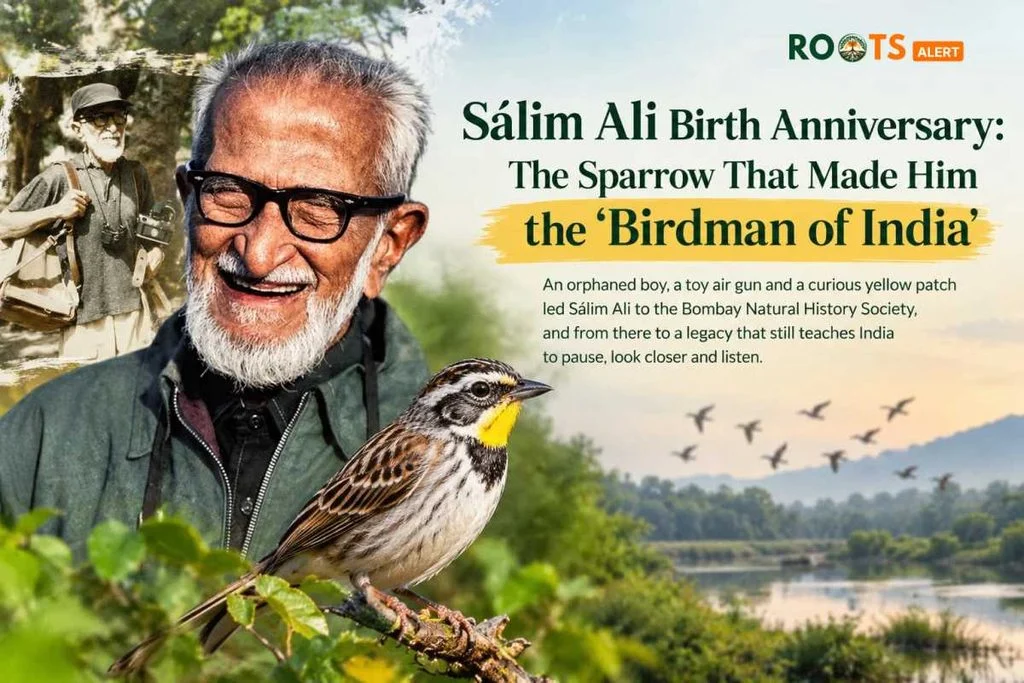
MUMBAI: Every great story has a small beginning. Sálim Ali’s was a sparrow no bigger than a child’s palm.
As India remembers Dr Sálim Ali, the “Birdman of India,” on the 130th anniversary of his birth (12 November 1896), the Bombay Natural History Society (BNHS) paid tribute to the man who, armed with a notebook, a pen and a pair of binoculars, brought India’s extraordinary birdlife into our lives. The day is also observed in India as National Bird Day.
The Yellow Patch That Started It All
Born in Bombay, Sálim Ali was the youngest of nine children and lost both parents very early in life. He was raised by his maternal uncle, Amiruddin Tyabji, and his aunt Hamida. His uncle gave him a toy air gun, and with it the boy shot a sparrow.
But something about the bird stopped him. Under its chin was a bright yellow patch, unlike the plain house sparrows he knew. He wanted to know what it was.
On his uncle’s suggestion, he carried the bird to the Bombay Natural History Society. There, W. S. Millard, the Society’s honorary secretary, identified it as a Yellow-throated Sparrow. Millard did not stop at naming it. He took the boy through the Society’s collection of preserved birds, opening a door that would never close again.
Years later, Ali titled his autobiography The Fall of a Sparrow, after the bird that began it all.
The Long Road of a Self-Taught Naturalist
His path was far from smooth. He struggled with formal schooling and left college without finishing. He went to Burma to help with the family’s mining business, and there, among the forests, his love of birds only deepened. Back in Bombay, he took up a modest job as a guide lecturer at the Prince of Wales Museum, then travelled to Germany to train under the ornithologist Erwin Stresemann in Berlin.
Returning home, he became the subcontinent’s most tireless field researcher. He conducted bird surveys of princely states such as Hyderabad, Cochin and Travancore, and trekked through Kutch, the Himalayan foothills and beyond. His careful study of the Baya Weaver’s nesting and breeding habits became a classic of Indian field ornithology.
Books That Put Birds in Every Home
Ali’s greatest gift was making science readable. The Book of Indian Birds, first published in 1941, became a trusted companion for generations of bird lovers. With S. Dillon Ripley, he produced the ten-volume Handbook of the Birds of India and Pakistan, a monumental reference that still guides ornithologists today.
A Scientist Who Spoke for the Wild
Ali used his reputation to argue for living landscapes, not just to catalogue species. He is remembered for his role in saving Bharatpur’s wetlands, now Keoladeo National Park, from hunting and disturbance, and for lending his voice to the campaign to protect Kerala’s Silent Valley. His work helped shape the BNHS into one of Asia’s foremost conservation institutions.
His honours included the Padma Bhushan (1958) and the Padma Vibhushan (1976), and he was nominated to the Rajya Sabha in 1985. He died on 20 June 1987, aged 90. Institutions such as the Sálim Ali Centre for Ornithology and Natural History (SACON) in Coimbatore carry his name forward.
Why His Story Still Matters
In an age of screens and constant noise, the BNHS tribute reminds us what Ali stood for: he taught us to pause, look closer and listen. With habitat loss, urban sprawl and climate change putting pressure on bird populations, that simple habit is also the first step towards protecting them.
Ali’s life carries a message for every child who picks up a binocular or asks “What bird is that?” A tragedy-marked childhood, an unfinished degree and no early advantages did not stop him. One question, asked at the right door, was enough.
Discover more from Roots Alert
Subscribe to get the latest posts sent to your email.